Same rent, different bill
Why expensas and utilities vary so much in Buenos Aires, and why they are now rising faster than rent.
Most rent comparisons in Buenos Aires stop at the rent. That misses a growing part of what a tenant actually pays. Expensas and utilities are now rising faster than rent, and they depend on things a listing rarely tells you: how many people the building employs, whether it has 24 hour security, how it is heated and how old it is. Two flats with the same rent can end up with very different monthly bills.
The USD 927 bill
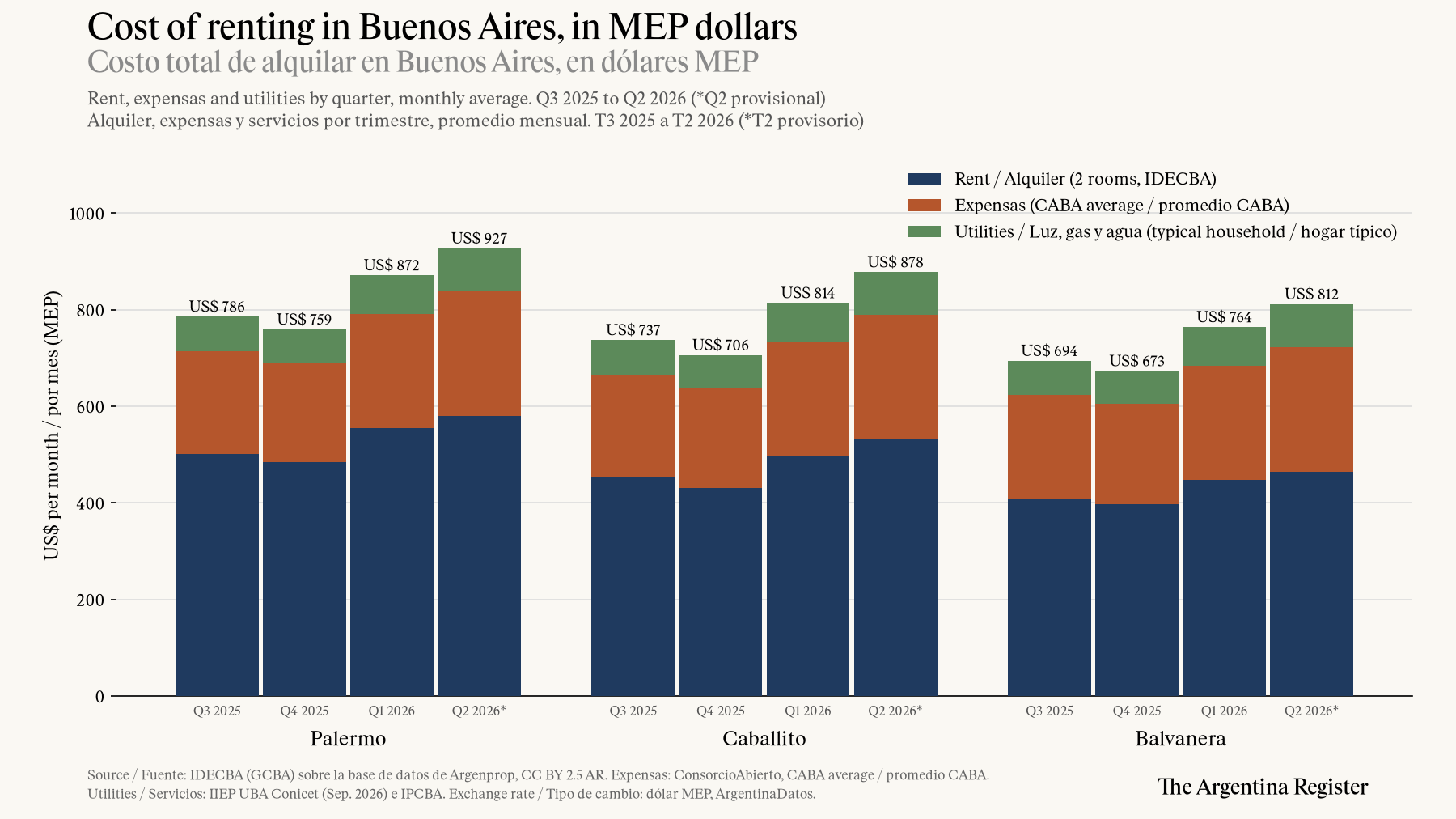
A typical 2 room apartment in Palermo cost about USD 927 a month all in during Q2 2026, at the dólar MEP rate. Rent was USD 580, expensas USD 258 and utilities USD 89. Rent is still the biggest piece, at about 63% of the total.
Swipe to see the full chart · Open full size
The more useful number is the change. Between Q3 2025 and Q2 2026 the Palermo total rose from USD 786 to USD 927, up USD 141. Rent added USD 79 of that, or 56%. Expensas added USD 45, or 32%. Utilities added USD 17, or 12%.
Expensas and utilities make up 37% of the bill but explained 44% of the rise. In pesos the gap is clearer: over the same period rent rose 23.7%, expensas 29.3% and utilities 32.4%. The extras are where the pressure is.
Expensas are a wage bill
Staff is the largest line in the average expensa, at 31% of the total in CABA according to ConsorcioAbierto, a building management platform that covers around 15,000 buildings. Administrators quoted in the press put it much higher in small buildings, at 60% to 75%, depending on how costs are classified.
That is why expensas follow the doormen's wage agreement more than general inflation. In the year to September 2026 the SUTERH pay scale for building staff rose 44.0%. The city's CPI line for building expenses (gastos comunes) rose 41.2%. City inflation was 32.9%. When the union signs a new scale, expensas move a month or two later, whatever the rest of the economy is doing.
Size helps, until security arrives
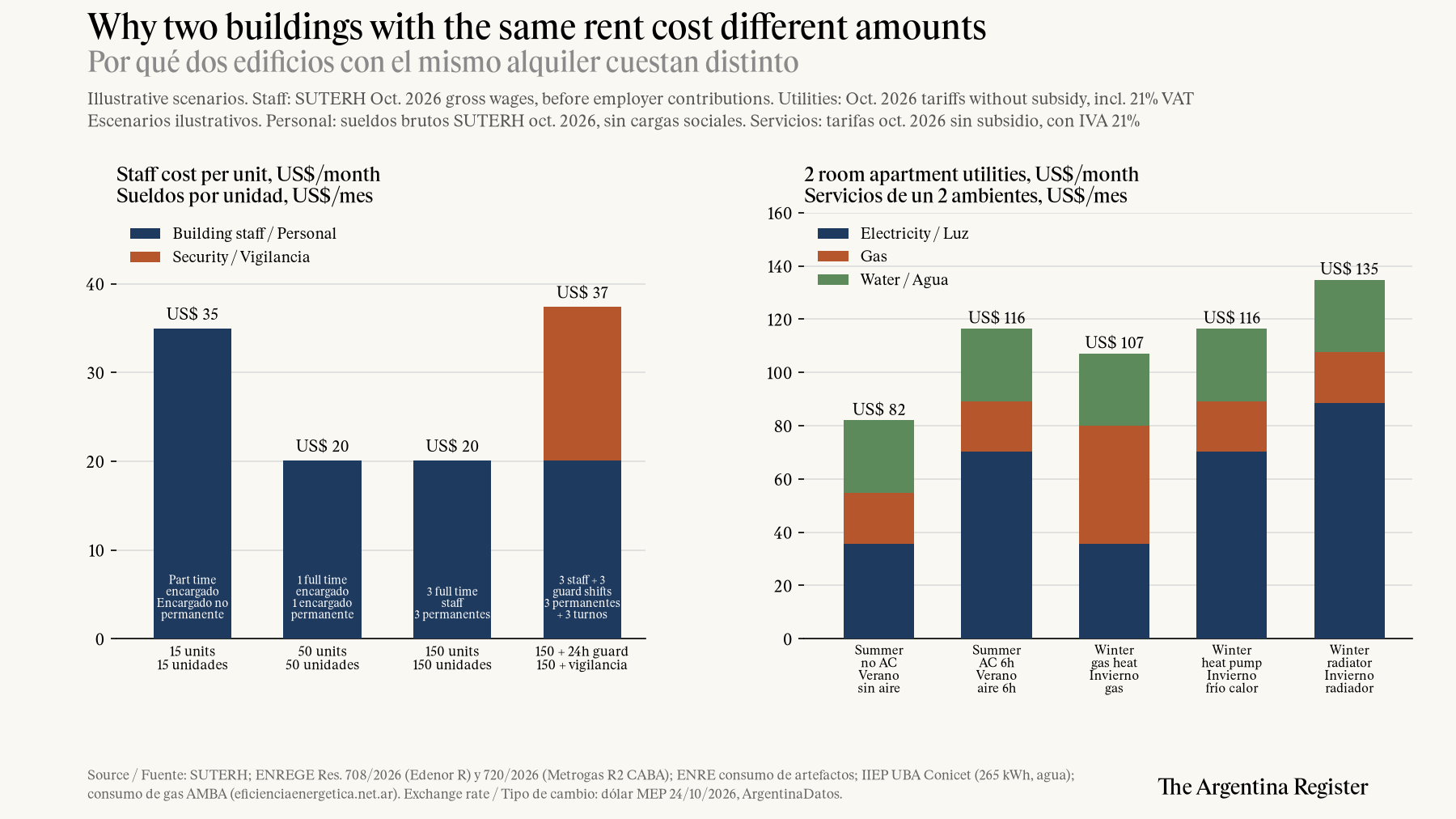
The same wage costs very different amounts per apartment depending on how many units share it. We built four illustrative buildings using the SUTERH October 2026 scale for first category buildings. These are gross wages only, before employer contributions, the year end bonus and extras, so real costs are higher. The staffing levels are our assumptions, not survey data.
| Building | Staff | USD per unit a month |
|---|---|---|
| 15 units | One part time encargado | 35 |
| 50 units | One full time encargado | 20 |
| 150 units | Three full time staff | 20 |
| 150 units | Three full time staff plus 24h security | 37 |
Two things stand out. A small old building with a part time encargado can cost more per apartment than a mid size building with a full time one, because the cost is split fewer ways. And scale stops helping once a tower adds round the clock guards. Covering 24 hours takes three to four extra salaries, and in premium buildings security can be up to 40% of the total.
Swipe to see the full chart · Open full size
Amenities and building age
Amenities matter less than most people assume. Industry estimates put the premium for buildings with a pool, gym or SUM at about 10% to 15%, or about 22% per m² in another study. Pools cost the most to run, partly because the staff scale adds a pool cleaning extra.
Age works differently. Older buildings often look cheap in ordinary months and then jump when the facade, the risers or the elevator need work. Extraordinary works are about 10% of the average expensa. In a standard lease those are the owner's cost, not the tenant's, but they still show up in what owners ask for.
Utilities depend on the season and the heater
Utilities are the most seasonal part of the bill. Using the October 2026 tariffs for households without subsidy (Edenor for electricity, Metrogas for gas in CABA), a reference consumption of 265 kWh a month and water at the AySA reference bill, a 2 room apartment looks like this:
| Scenario | USD a month |
|---|---|
| Summer, no air conditioning | 82 |
| Summer, air conditioning 6 hours a day | 116 |
| Winter, gas heating | 107 |
| Winter, air conditioner as heat pump 6 hours a day | 116 |
| Winter, electric radiator 6 hours a day | 135 |
There is also a cliff in the electricity tariff. Above 400 kWh a month the fixed charge jumps from ARS 3,866 to ARS 12,697. Heavy air conditioning or a radiator can push a small flat over that line, so it pays twice: more energy and a higher fixed charge.
Buildings with central heating move the gas bill out of the tenant's own account and into expensas. In one 40 unit building cited by an administrator, winter gas reached about ARS 2 million of a ARS 6 million monthly budget, roughly 30%. That is one example, not an average, but it shows why expensas in centrally heated buildings swing with the weather.
What to budget
For a 2 room flat in Palermo with average expensas, season and heating alone move the monthly total between about USD 920 and USD 973. A small building or one with 24 hour security adds roughly USD 15 to USD 17 per apartment in gross staff wages on top of that, more once employer contributions are counted. The quoted rent is the starting point, not the bill.
What to ask before signing
- How many staff does the building employ, full or part time, and is there 24 hour security?
- How many units share the expensas?
- What were the last three expensas statements, and are any extraordinary works planned?
- Is heating central or individual, gas or electric? Is there air conditioning, and what kind?
- Which amenities are included, and is there a pool?
Method and caveats
- Rent is the IDECBA average asking rent for used 2 room apartments. Q2 2026 is provisional.
- Expensas in the all in series are one citywide average from ConsorcioAbierto, moved with the IPCBA building expenses line from Q4 2025. They are the same for every barrio.
- Utilities in the all in series are a typical household estimate based on IIEP UBA Conicet and IPCBA, using September consumption, so winter is understated.
- Staffing scenarios are illustrative. Wages are gross SUTERH basics plus the general monthly extra, without employer contributions, year end bonus or other extras.
- Utility scenarios use tariffs for households without subsidy and add 21% VAT only. Municipal and provincial charges are excluded, so these are a floor. Households with subsidies pay much less. Monthly billing categories are approximated from monthly use.
- Gas heating use (100 m³ in a winter month) is an AMBA household average that includes houses, so it is likely high for a small flat. Air conditioning uses the official consumption figure for a 3500 frigorías inverter unit.
- Dollar figures use dólar MEP: quarterly averages for the series, 1,563.9 pesos on 24 October 2026 for the scenarios.
Sources
- IDECBA, Ciudad de Buenos Aires: rents and IPCBA (CC BY 2.5 AR).
- SUTERH, October 2026 pay scale
- Ámbito, ConsorcioAbierto breakdown, September 2026
- El Cronista, amenities and security
- iProfesional, expensas per m²
- Clarín, central heating in winter
- ENREGE Res. 708/2026, Edenor tariffs
- Metrogas tariffs, October 2026 (Res. ENREGE 720/2026)
- ENRE, appliance consumption
- IIEP UBA Conicet, tariffs and subsidies report
- Residential gas use in AMBA
- Dólar MEP: ArgentinaDatos.